Institute for Medical Information Processing, Biometry, and Epidemiology (IBE)
Teaching and Continuing Education
Staff members of the Chair of Public Health and Health Services Research are engaged in a wide range of teaching and continuing education activities and projects. They develop and coordinate courses, communicate current subject knowledge, and support learners throughout their academic and professional development.
Staff members of the Chair are actively involved in teaching activities at the Faculty of Medicine, design and coordinate courses offered through the Virtual University of Bavaria (vhb), organize summer schools on a range of topics, and participate in other teaching-related activities, teaching projects, and continuing education. The Digital Public Health SkillsLab provides students and staff with a platform for experiments and learning in areas such as AI, data science, and digital public health.
Master's Program M.Sc. Public Health
In the Master's Program in Public Health, staff members of the Chair are responsible for or teach a large proportion of the compulsory and compulsory elective modules. Some courses are taught jointly with the Master's Program in Epidemiology.
In MeCuM Science, staff members of the Chair of Public Health and Health Services Research give lectures and seminars on evidence-based medicine and epidemiology.
Courses offered as part of Module 6 (Practical semester)
Module 6 offers various seminars on scientific practice and study designs. These range from courses on planning surveys and designing questionnaires and "On a Scale from 1 to 10, How Valid Is My Questionnaire?" - An Introduction to Psychometrics, to "Two Is Better Than One": Mixed Methods in Health Research.
ÖGW Kompass – Making an Impact Together
The LMU companion program for medical students interested in public health and population medicine
At LMU Munich, the ÖGW Kompass companion program was developed to provide students with structured access to this multifaceted discipline. It is primarily aimed at students with a public health quota, but is also open to all other medical students interested in public health and population medicine. The program not only provides specialized knowledge and practical experience but also fosters an understanding of the importance of public health within the broader societal context.
Staff members of the Chair deliver introductory lectures on health sciences focusing on epidemiology, prevention, health promotion, public health, and health economics for students of the dentistry program.
Ph.D. Programs
Ph.D. Program Medical Research in Epidemiology & Public Health
Ph.D. Program Medical Research - International Health
Staff members of the Chair of Public Health and Health Services Research contribute to the Ph.D. Program Medical Research – International Health at the Center for International Health (CIH).
Courses Offered by the Virtual University of Bavaria (vhb)
Various courses for the Virtual University of Bavaria have been developed in cooperation with several Bavarian universities. All courses are offered on an ongoing basis.
CLASSIC vhb courses complement the curricula of the Master's Programs in Public Health and Epidemiology. They can also be taken by students from other Bavarian universities.
OPEN vhb courses are non-curricular online courses. Interested participants can use them free of charge.
Our course portfolio comprises the following courses:
CLASSIC vhb Courses (with Assessment) for Students at Bavarian Universities
Planetary Health - A Comprehensive Health Concept
Planetary Health - A Holistic Vision for People and the Planet (for students in English-language degree programs)
Healthy and Sustainable Urban Development
Digital Public Health: AI Fundamentals and Applications
OPEN vhb Courses for Interested Participants (after registering with vhb)
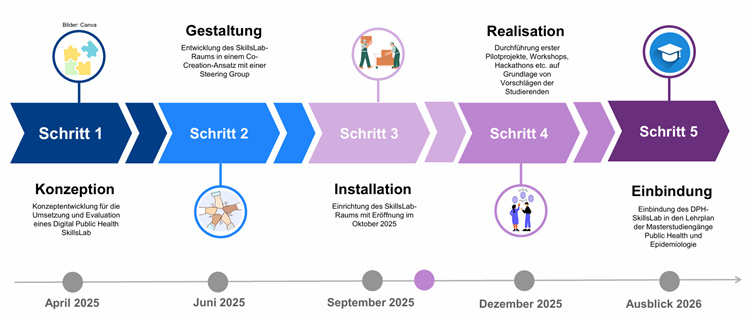
With support from the "Freiraum 2025" funding program of the Foundation for Innovation in Higher Education, the Digital Public Health SkillsLab is being established at the Chair of Public Health and Health Services Research from 2025 to 2027. It creates a learning, experimentation, and training environment for students and teaching staff in which they can acquire knowledge and skills in digital public health, including in areas such as AI, health apps, usability/UX, cybersecurity, and project management. The SkillsLab is intended to create a space in which new digital public health ideas can be developed and implemented.
The project aims to help establish digital public health in public health, epidemiology, and medical education. In the medium term, the SkillsLab is to be permanently embedded in the curricula of the Master's Programs in Public Health and Epidemiology.
Projects and activities implemented to date include:
R Party for students
Codebar Munich workshop
Workshop on social entrepreneurship and podcasting
Field trip: From Aerospace to Medicine: Exploring the Future of Additive Manufacturing
If you are interested in the Digital Public Health SkillsLab, please contact us by email: info@dph-skillslab.de
Figure: Overview of the development of the Digital Public Health SkillsLab
European Summer School in Evidence-Based Public Health
The European Summer School in Evidence-Based Public Health aims to provide participants with in-depth knowledge and practical skills to effectively integrate scientific findings into public health practice. The event is designed for healthcare professionals, PhD students, and researchers interested in applying evidence-based methods in public health.
The EBPH Summer School takes place annually over five days in July in Munich. The language of instruction is English.
Planned as a one-week, in-person program in Munich the Summer School aims to strengthen participants’ capacity to collaboratively design and conduct participatory research. The program will explore structural inequalities and their intersections in the context of migration, focusing on research approaches that advance health equity and contribute to inclusive and diversity-sensitive health services.
Master’s and doctoral students, researchers, civil society staff, practitioners supporting migrants and people with lived experience of migration, with varying levels of research experience, will engage in a shared learning process that brings together scientific knowledge, practice-based knowledge and lived experience. Through dialogue-based and creative methods, participants will reflect on power relations, ethical responsibilities and shared decision-making, jointly developing a research plan to practice knowledge co-production and explore how research can inform practice.
Further Teaching-Related Activities and Continuing Education
Continuing Education on the International Classification of Functioning, Disability and Health (ICF)
The World Health Organization's International Classification of Functioning, Disability and Health (ICF) provides a common language for taking a holistic view of health, functioning, and participation. The Chair of Public Health and Health Services Research offers practice-oriented ICF training that provides foundational knowledge and supports the use of the ICF in a range of professional contexts.
The training on the International Classification of Functioning, Disability and Health (ICF) is delivered by staff members of the Chair of Public Health and Health Services Research. All trainers have many years of experience teaching and applying the ICF.
Online training courses and in-house training are offered.
PULSE is a strategic project of LMU Medizin. It aims to attract outstanding international talent to study, conduct research, and pursue a career in Germany, to support them, and to retain them over the long term. The project focuses on public health, epidemiology, artificial intelligence, and data science. It prepares future leaders to develop evidence-based solutions to challenges in healthcare and the public health service.
LMUexcellent Project Master`s program Epidemiology
The “Project to Increase the Number of Qualified Students in the Master`s program Epidemiology and to Establish an International Network for Research and Teaching in Epidemiology” (LMUexcellent Project Master`s program Epidemiology) aimed to increase the number of qualified students and the international visibility of the Master’s program in Epidemiology, as well as to facilitate the establishment of a network for research and teaching in epidemiology.
As a first step, an online survey was conducted among current students and alumni to identify the reasons for choosing the Master’s program in Epidemiology at LMU Munich. To strengthen the program’s international visibility, its website was redesigned and updated with features such as current testimonials. An information event for prospective students was established, and a long-term social media strategy was developed.
To build the network, a concept was developed for a LinkedIn channel to be named “EpiConnect – The LMU Epidemiology Network.” As a digital platform, it is intended to connect students, alumni, universities, and research institutions and to centralize information on internship, master’s, and doctoral opportunities, as well as job openings.
The project was funded through the LMUexcellent Study Program Development Fund for a two-year period from October 1, 2024, to September 30, 2026.
Further Development and Quality Assurance of the Public Health Officer Training Course
As part of a cooperation project with the Academy at the Bavarian Health and Food Safety Authority (AGL), the curriculum of the Bavarian Public Health Officer Training Course is being revised, learning objectives are being specified more precisely, and interfaces with other curricula are being identified to further develop the course and assure its quality. A further focus is on developing new teaching formats and identifying new content to be included in the new curriculum.
The project is funded by the Bavarian State Ministry of Health, Care and Prevention (project period: January 2026 to December 2027).
Statistical Consulting for Students and Doctoral Candidates
The statistical consulting service is intended for students and doctoral candidates at LMU's Faculty of Medicine (Human Medicine and Dentistry). It includes, for example, advice on study design, sample size planning, and analysis strategies. Methodological and statistical consulting is free of charge and is provided in up to three appointments. Further information can be found here.